


For millions of years, the Yoyo-Yolanda reservoir has rested beneath the restless grey waters of the Gulf of Guinea, not knowing the invisible maritime line that splits it between Cameroon and Equatorial Guinea (EG).
Since 2007, however, this shared offshore gas field has been locked in a diplomatic tug-of-war, earning the reputation as the Gulf’s most intractable gas puzzle.
“It’s one bird with two names,” explained Samuel Dinga, a former geophysicist at Cameroon’s National Hydrocarbons Corporation (SNH). “We call it Yoyo; they call it Yolanda. But if one side drills too fast, the other side’s pressure drops. It’s like two people drinking from the same glass with two different straws.”
For more than a decade, that “straw dispute” kept billions of dollars in investment on hold.
International majors such as Chevron circled cautiously, unwilling to commit capital to a field where unresolved borders could turn a multi-billion-dollar platform into a liability.
The stalemate was never just technical; it was also about national pride. Which country would host the processing plant? Whose citizens would secure the jobs?
The breakthrough came in March 2023, when both governments finally ratified a Bilateral Treaty. The realisation had dawned that as the world accelerated toward renewables, their “stranded gas” was losing its window of value. The treaty shifted the conversation from borders to shared benefits, unlocking the potential of a reservoir that had long been trapped in political limbo.
The Yoyo-Yolanda field is a single, contiguous gas-condensate reservoir straddling the maritime boundary, with an estimated 2.5 trillion cubic feet (tcf) of natural gas— reserves significant enough to underpin LNG exports or feed regional gas infrastructure.
The hidden knots of Yoyo-Yolanda
Much of the recent diplomatic row between Cameroon and EG has revolved around the protracted joint development of a cross‑border gas field straddling both countries.
Discovered in 2007 by Noble Energy (now Chevron), the gas‑condensate reservoirs lie within Cameroon’s Douala Basin and Equatorial Guinea’s Block I.
Located roughly 50 kilometers east of Bioko Island in deep waters at about 896 metres, the fields overlap with Cameroon’s Etinde gas field and EG’s Camen and Diega fields.
Yet, despite their strategic significance, progress stalled for years. The commercial and legal complexities of transboundary resource development triggered drawn‑out negotiations between the two governments and Chevron, compounded by tensions over the Kye‑Ossi border dispute, which left hundreds injured and caused widespread property damage.
A breakthrough came in October 2016, when Cameroon and EG agreed to exchange geological data, paving the way for a Memorandum of Understanding in 2017.
This MoU formally recognized Yoyo‑Yolanda as a single, contiguous reservoir and established a framework for joint development.
Momentum resurfaced in March 2023, when the two countries signed a landmark bilateral treaty, providing a definitive legal framework for unitization and development.
By January 2025, the treaty had been ratified by both national parliaments and deposited with the United Nations Secretariat, granting it binding and irreversible status.
The rapprochement that enabled this milestone was closely monitored—and discreetly encouraged—by Washington, underscoring the geopolitical weight of the Yoyo‑Yolanda fields.
The big spin in the Yoyo-Yolanda crisis
After nearly three years of intensive negotiations, a finalised unitisation agreement was signed on February 3, officially merging the separate leases into a single operational structure under Chevron’s management.
With this accord, Cameroon and Equatorial Guinea have agreed to treat the Yoyo‑Yolanda fields as one unified project—transforming the dynamic from rivalry to cooperation and underscoring the principle that both nations stand to gain more together than apart.
Energy analyst Ayomide Anifosowe explained: “From a commercial standpoint, unitization of the Yoyo‑Yolanda project is the most sensible and practical joint‑venture structure available.
“It simplifies the path to FID and enhances the project’s bankability. It makes sense for Chevron to align both governments around a single, unified development framework to accelerate development.”
Oil and gas expert Etulan Adu also said: “Without this agreement, both nations would have been incentivized to pump aggressively to drain the other’s side—a race to the bottom that destroys reservoir pressure and wastes capital.
“With 84% of the joint reservoir under Cameroon’s territory, it will provide the bulk of the volume, while Equatorial Guinea controls the remaining 16% and key processing facilities essential for the gas.”
Chevron’s $4 billion push toward execution
Moreover, Chevron, acting through its subsidiaries Noble Energy EG Ltd. and Noble Energy Cameroon Ltd., emerged as the technical operator of the Yoyo‑Yolanda project. ‘
Under the February 3 unitization agreement, the U.S. major has been granted authority to conduct drilling and production operations seamlessly across both sides of the maritime border, eliminating the regulatory frictions that often stall cross‑border ventures.
Rather than fixating on boundary coordinates, Chevron has focused on a unified industrial blueprint designed to transform the buried gas into a marketable commodity.
Its $4 billion investment plan outlines a clear path to execution, including:
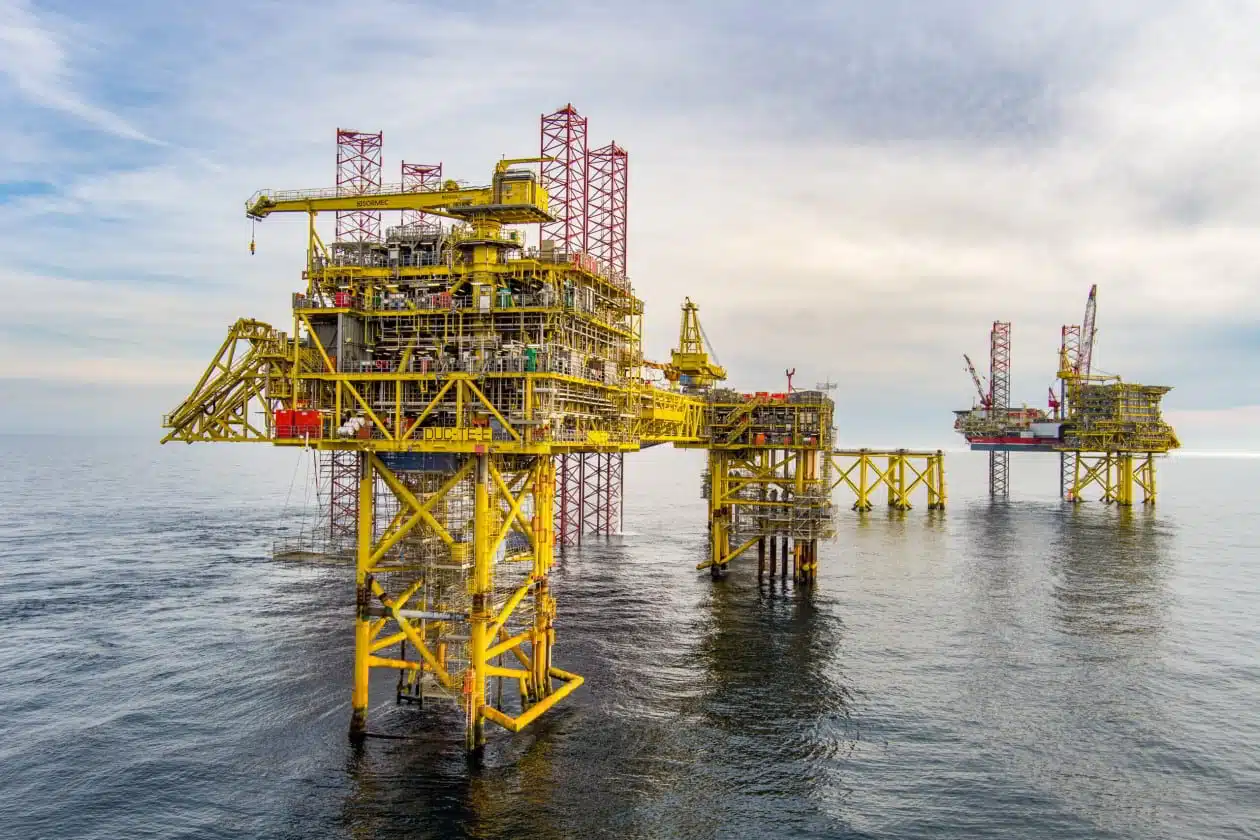
- Central Processing Platform: Installation within the Yoyo block to serve as the hub of operations.
- Development Wells: Drilling of three wells to unlock reservoir potential.
- Subsea Pipelines: Construction of dual transport routes—one to Cameroon’s Bipaga processing center and another to Equatorial Guinea’s Punta Europa complex.
Jim Swartz, Chevron’s Managing Director for Nigeria & Mid‑Africa, emphasised: “The Yoyo‑Yolanda project is central to Chevron’s strategy of supporting long‑term LNG supply and leveraging existing infrastructure at Alen and Punta Europa.”
The project’s governance also reflects balanced national interests.
Cameroon’s Société Nationale des Hydrocarbures (SNH) holds a 25% stake in the Yoyo field, while Equatorial Guinea’s state‑owned GEPetrol controls 32.55% of the Yolanda field following Atlas Oranto’s exit.
With the legal framework ratified, the operator empowered, and financing mapped out, Chevron is positioned to move the Yoyo‑Yolanda project from negotiation into tangible execution—turning a once‑stalled cross‑border controversy into a cornerstone of regional LNG supply. It is not immediately clear when actual construction will start.
A mutual victory for two neighbours
The Yoyo‑Yolanda project is a strategic lifeline for Cameroon and Equatorial Guinea, though their priorities differ. At its core, the venture monetises stranded gas that would be too costly to develop separately.
“Yoyo‑Yolanda is a clear win‑win,” said analyst Ayomide Anifosowe. “Equatorial Guinea can leverage its Punta Europa processing facility to cut costs and speed timelines, while both countries stand to ramp up production beyond current modest levels.”
For Equatorial Guinea, the project feeds into its Gas Mega Hub (GMH) initiative, a national multiphase plan to transform underutilised gas into export revenue and industrial growth. GMH phases already underway include:
- Phase 1: Alen Gas Monetisation Project
- Phase 2: Alba Tail Gas Monetisation Project
- Phase 3: Aseng Gas Monetisation Project
In September, Chevron signed a $690 million Incentives Agreement with EG to advance Phase 3.
Cameroon’s focus is domestic. Gas from the Yoyo field will supply the Perenco‑operated Bipaga facility, powering plants to meet the country’s goal of universal electricity access by 2035. National demand is expected to quadruple, yet only 71% of Cameroon’s 30 million people currently have electricity, at some of the region’s highest costs.
To close the gap, the World Bank awarded a $1 billion facility in January 2025 to expand Nachtigal Hydropower Station from 60MW to 360MW, lifting renewables to about 30% of the energy mix. Beyond power, Cameroon plans to channel gas into industries such as fertiliser and thermal generation, reducing reliance on costly imports.
A rescue rope for two struggling economies?
The governments of Cameroon and EG are both facing a structural downward trend in oil revenues, driven by maturing fields and declining production, though the scale of impact differs significantly due to their varying levels of economic diversification.
Oil revenues now account for less than 10% of Cameroon’s national budget—down from 25% in previous years—because of steady reduction in oil production.
EG faces a more severe crisis as hydrocarbons account for 90% of total public revenue and 95% of exports. Output has plummeted from 241,000 barrels per day (bpd) in 2010 to approximately 56,890 bpd at the end of 2024.
The IMF and African Development Bank project a continued recession and fiscal deficits through 2025–2026 as hydrocarbon production continues its structural decline, even as the country’s public debt is projected to balloon due to lower oil earnings.
Against this backdrop, the cross-border Yoyo-Yolanda project has emerged as a critical lifeline, offering Cameroon and Equatorial Guinea a chance to stabilize revenues and secure long-term gas income flows. With unitisation now complete, attention turns to execution — and analysts warn that timelines must be accelerated to keep pace with evolving market dynamics.
NJ Ayuk, Executive Chairman of the African Energy Chamber, underscored the urgency: “There is a tight window to monetise Africa’s Gas resources before global market dynamics shift — delaying is not an option.”
He celebrated the unitisation agreement, but stressed: “Governments must eliminate red tape, accelerate execution and leverage existing infrastructure to maintain investor confidence.”
“The timing aligns with the maturity of Equatorial Guinea’s Gas Mega Hub at Punta Europa. Only now does the region possess the space needed to monetise these volumes on a global scale,” Adu echoed the same sentiment.
“By pooling reserves and infrastructure, the Gulf of Guinea is transforming itself into a competitive global region, proving that regional cooperation could be an effective hedge against the uncertainties of the global energy transition.”
The Yoyo-Yolanda story is one of transformation — turning nearly a decade of diplomatic deadlock into a bankable asset. The delays highlight the barriers to African energy integration, but the breakthrough demonstrates that reconciling differences requires more than symbolic gestures. It is about building frameworks that extend beyond bilateral ties and create regional resilience.
If Cameroon and Equatorial Guinea can successfully bridge their divides to unlock shared resources, doesn’t this suggest that other African producers could do the same — connecting assets, pooling infrastructure, and reshaping the continent’s energy future?