
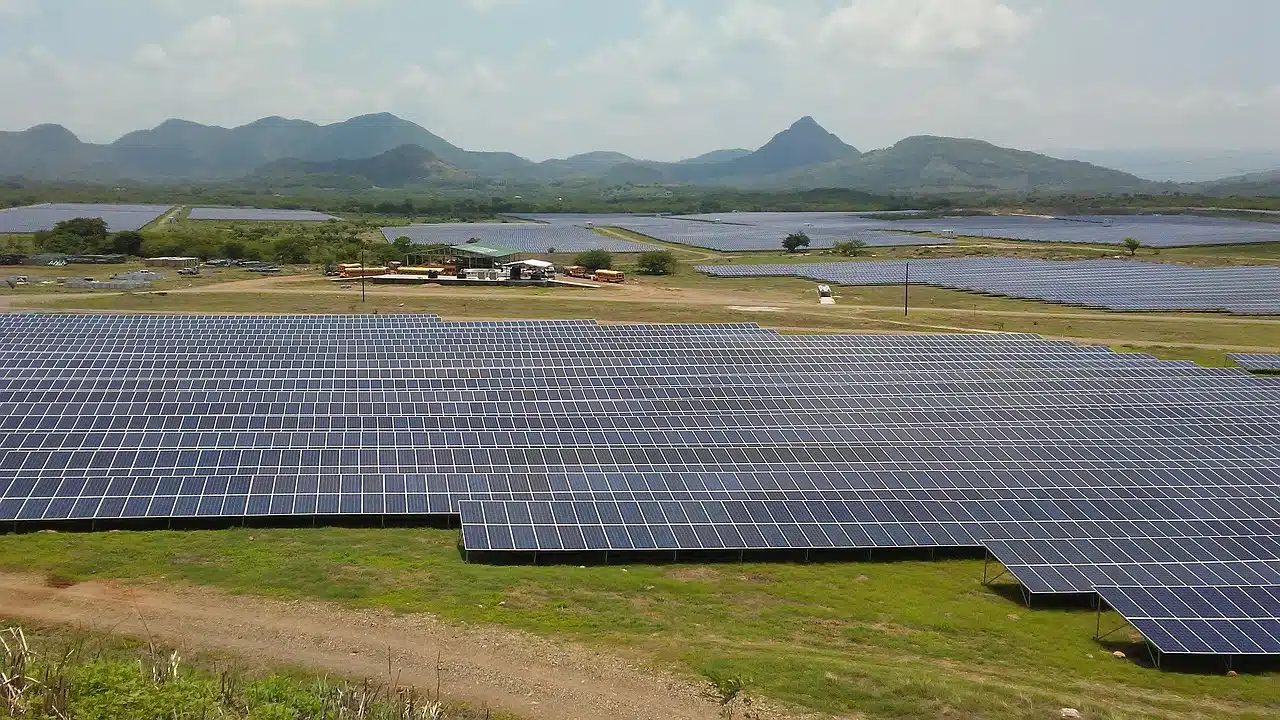


Africa’s renewable energy industry recorded major progress in 2025 as rising electricity demand, improved policy frameworks, and stronger private investment accelerated the rollout of large solar plants.
According to the Africa Market Outlook for Solar PV 2025–2028 report, the continent holds 60% of the world’s highest-quality solar resources. Yet solar provides only 3% of Africa’s electricity generation.
The year’s largest utility-scale solar completions showed a shift toward grid-connected capacity. They also demonstrated stronger policy commitment in Egypt, South Africa and Morocco.
Solar projects dominated new capacity additions. The five largest utility-scale completions represent a major step toward grid-connected clean power.
5. HDF Green Hydrogen Solar PV Project, Kenya
Kenya reached a notable achievement in 2025 with the HDF Green Hydrogen Solar PV Project. The 180-megawatt facility combines solar generation with green hydrogen production for industrial use.
The plant sits in Kitui County, covering a desert-like area with high solar irradiation. The site’s design allows efficient energy conversion and supports hydrogen electrolysis during the day.
The project reduces reliance on diesel generators and lowers carbon emissions. Annual CO₂ reductions are projected at over 120,000 tons.
The plant is fully connected to the national grid, supporting both local consumption and industrial supply.
Developers say the project strengthens Kenya’s energy security.
“This facility shows how solar and hydrogen can work together for reliable clean power,” said a spokesperson from HDF Energy Kenya.
The project represents a significant step for East Africa in hybrid solar and green hydrogen deployment.
4. Grootfontein Solar PV Plant, South Africa
South Africa’s Western Cape added its largest solar cluster in December when Scatec’s 273-megawatt Grootfontein project entered commercial operation.
It is the first plant from the fifth round of the Renewable Energy Independent Power Producer Procurement Programme (REIPPPP) to reach full operations.
Norwegian developer Scatec ASA announced the start of operations and confirmed the project as its first installation in the Western Cape.
“We are proud to commence commercial operations at Grootfontein, reinforcing our strong track record in South Africa.
“This project builds on our commitment to deliver clean, reliable energy while creating long-term value for local communities and partners,” Scatec CEO Terje Pilskog said.
Alberto Gambacorta, General Manager for Sub-Saharan Africa, added: “Bringing the Grootfontein plant into operation is an important milestone for Scatec and our partners. As our first project in the Western Cape, and the first solar project to reach COD under REIPPPP Round 5.”
The plant is supported by a 20-year power purchase agreement. It will generate about 700 gigawatt hours of electricity each year.
The project comes at a time when South Africa continues to face load-shedding and needs new capacity on the grid.
3. Leeuwspruit Solar Project, South Africa
The Free State province gained a major solar asset in early 2025. The 100-megawatt Leeuwspruit plant, part of the Kroonstad PV Cluster, officially entered operations.
The plant produces about 220 gigawatt-hours annually. This is enough electricity to power 80,000 homes each year.
It avoids roughly 180,000 tons of carbon emissions annually. Scatec emphasized its role in diversifying South Africa’s renewable portfolio.
Construction began in the first quarter of 2024. The project cost $120 million. Ground-mounted solar arrays cover 200 hectares, and bifacial panels enhance energy efficiency.
It helps ease strain on the coal-heavy grid in the region. Operation and maintenance are managed locally.
This REIPPPP project strengthens provincial renewable energy goals. An expansion to 200 MW is under review. It aligns with NERSA reforms and achieves a high 85% capacity factor due to strong irradiation.
2. Oulad Farès Solar PV Plant, Morocco
Morocco advanced its industrial clean energy agenda with the inauguration of OCP Group’s new 105-megawatt Oulad Farès solar plant in Khouribga.
The project is part of a larger 202-megawatt portfolio launched in December. It is now Morocco’s largest photovoltaic installation.
OCP Group confirmed the start of operations across three new solar farms. Total investment reached about 1.8 billion Moroccan dirhams, or €165 million ($180 million).
Abdelkrim Ramzi, Director of OCP’s Khouribga Integrated Platform, said the projects already supply the company’s mining and industrial sites.
“We now meet 100% of the daytime electricity needs at Khouribga and Gantour with solar energy,” he said.
The Oulad Farès plant produces roughly 200 gigawatt-hours annually. It cuts about 150,000 tons of carbon emissions per year.
The site is designed to support OCP’s phosphate operations through direct supply. International finance partners, including IFC and KfW, backed the projects.
The company plans to scale its renewable portfolio to 470 megawatts by 2027. Benguerir and Foum Tizi add the remaining 97 megawatts in this phase.
The program strengthens Morocco’s efforts to expand clean energy while reducing industrial electricity costs.
1. Bolobedu Solar Plant, South Africa
South Africa added another major solar facility with the Bolobedu plant, which supports mineral sands producer Richards Bay Minerals, a subsidiary of Rio Tinto.
The project is backed by a 20-year private power purchase agreement signed in 2022. It is scheduled for completion in 2025.
The plant will supply about 300 gigawatt-hours of electricity per year. Annual production matches the consumption needs of about 425,000 people.
Its output reduces approximately 237,000 tons of carbon dioxide emissions. That reduction equals the removal of about 50,000 petrol vehicles from the road.
The initiative provides Richards Bay Minerals with an alternative supply option as South Africa continues to manage rolling blackouts.
The plant is located in Limpopo Province. It helps diversify South Africa’s renewable footprint beyond traditional development zones. It also strengthens private-sector participation in clean energy procurement.
Bottom line
Africa’s solar market expanded significantly in 2025 as large projects in Egypt, South Africa and Morocco pushed new capacity to the grid.
They reduce millions of tons of emissions each year. Solar plants also help governments cut fossil fuel dependence and address persistent supply gaps.
Hybrid systems and battery storage improve reliability. Stronger policies and new financing instruments supported development.
According to the International Renewable Energy Agency (IRENA), challenges persist in the renewable energy sector particularly high capital costs in emerging markets and grid integration constraints that delay project deployment.
However, competitive auctions and long‑term contracts such as power purchase agreements are helping to strengthen investment frameworks and support further growth